
Loose Flanges
- 1.4301, 1.4307…
Stainless steel forged loose flange DN40 48,3mm EN1092-1/02A (PN10/16/25/40) 1.4301 / 1.4307 / 304 / 304L
in stock21,69 € (17,63 € excl. VAT)Add to basket
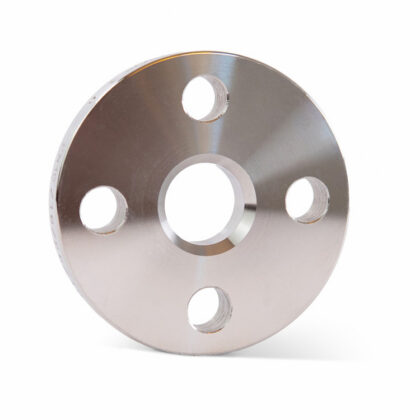
Loose flanges – what are they?
Loose flanges (also known as lap joint flanges) are a type of flange that is not permanently attached to the pipe, but rather slides freely over it or over a short attachment component called a stub end. This allows the flange to rotate relative to the pipe, which facilitates installation and bolt alignment during the connection of pipelines. These flanges are commonly used where frequent disassembly/inspection of connections is required or when the pipe material requires separate joining (e.g., in systems with replaceable components).
Structure and characteristic features
A typical loose flange assembly consists of:
- loose flange– a ring with bolt holes that slides over the attachment element;
- stub end– a short element welded or mounted to the pipe, on which the loose flange rests;
- sealing– an appropriate gasket selected for the operating conditions (temperature, medium, pressure).
Loose flanges come with different types of mating surfaces (e.g., raised face (RF), flat face (FF), RTJ) – the choice depends on pressure and tightness requirements.
What steels do we use for loose flanges?
Our offer includes flanges made exclusively of corrosion-resistant and high-temperature-resistant steels. The most commonly used materials are:
- stainless steel– e.g., AISI 304 (EN 1.4301) – for general use, good corrosion resistance under standard conditions;
- acid-resistant steel– e.g., AISI 316L (EN 1.4404) – better resistance to chlorides and chemical environments, often used in the chemical, marine, and food industries;
- heat-resistant steel– e.g., AISI 310 (EN 1.4845) and related grades – used where elevated temperatures and oxidation occur.
In the product descriptions, we use both colloquial names (stainless steel, acid-resistant steel, heat-resistant steel) and technical designations (AISI/ASTM for the USA, EN/1.x for Europe) to facilitate the selection of the appropriate material.
Where and in which industries are loose flanges used?
Loose flanges are widely used in piping installations where easy assembly, flange rotation capability, and quick disassembly are important. Typical industries and applications:
- chemical and petrochemical industry – process installations and transport of aggressive media (in combination with acid-resistant steel);
- food and pharmaceutical industry – installations requiring frequent disassembly and cleaning;
- offshore and shipbuilding – marine installations where corrosion resistance and the possibility of replacing elements are key;
- HVAC and water installations – water, steam, and coolant transmission systems;
- automotive and heavy industry – exhaust systems, technological sewage;
- construction and sanitary installations – connections where ease of assembly is required;
- small workshops and garage projects – where simple assembly and the possibility of later modification are important.
Standards, dimensions, and flange selection
Loose flanges are manufactured in accordance with commonly used standards and pressure classes, including:
- EN/DIN (e.g., EN 1092-1) – typical for the European market;
- PN (PN10, PN16, PN25, etc.) – pressure classes used in Poland and Europe;
- ANSI/ASME (e.g., ASME B16.5) – standards often used on the American market (e.g., Class 150/300).
When selecting a flange, pay attention to: nominal pipe diameter (DN/NPS), pressure class, material, sealing surface type, and surface treatment requirements (e.g., polishing in the food industry).
Why choose loose flanges?
Loose flanges offer several practical advantages:
- ease of alignment and assembly thanks to the ability to rotate the flange;
- simplified disassembly of the installation for maintenance or replacement of elements;
- the possibility of using different materials for the flange and stub end depending on corrosion and temperature requirements;
- versatility of applications – from small installations to heavy industry and offshore.
How to choose a flange – practical tips
When choosing a loose flange, define the basic parameters of the installation: type of medium, operating temperature and pressure, required tightness class, pipe diameter, and environment (e.g., seawater, chemicals). For corrosive installations, choose acid-resistant steel (e.g., AISI 316L / EN 1.4404), and where high temperatures occur – heat-resistant steel (e.g., AISI 310 / EN 1.4845). If you are not sure, our specialists will help you choose the material and standard in accordance with the project requirements.
Need help?
If you have questions regarding sizes, materials (e.g., 1.4301, 1.4404, 1.4845), standards (EN, DIN, ASME), or would like to receive an offer for loose flanges for a specific application – please contact us. We will help you choose the best solution tailored to your needs.
Steel grades
Each grade has its own page with chemical composition, equivalent designations and the full list of products in stock.
Acid-resistant
Austenitic with molybdenum – resistant to pitting and crevice corrosion; for chemicals, processing and chloride environments.
Austenitic stainless
Chromium-nickel without molybdenum – the standard choice for structures, food service and interiors.
Heat-resistant
Higher chromium and silicon – retain strength and scaling resistance at high temperatures.
Ferritic
Chromium without nickel – cheaper, magnetic, good where atmospheric corrosion resistance matters.