
Eccentric Reducers
- 1.4301, 1.4307…
Stainless steel seamless eccentric reducer DN80 88,9 x 3,05mm / DN50 60,3 x 2,77mm in grade 1.4301 / 1.4307 / 304 / 304L
in stock19,52 € (15,87 € excl. VAT)Add to basket - 1.4401, 1.4404…
Stainless steel seamless eccentric reducer DN80 88,9 x 3,05mm / DN50 60,3 x 2,77mm in grade 1.4401 / 1.4404 / 316 / 316L
in stock28,47 € (23,15 € excl. VAT)Add to basket - 1.4301, 1.4307…
Stainless steel seamless eccentric reducer DN80 88,9 x 3,05mm / DN65 76,1 x 2,9mm in grade 1.4301 / 1.4307 / 304 / 304L
in stock16,93 € (13,76 € excl. VAT)Add to basket - 1.4401, 1.4404…
Stainless steel seamless eccentric reducer DN80 88,9 x 3,05mm / DN65 76,1 x 2,9mm in grade 1.4401 / 1.4404 / 316 / 316L
in stock24,47 € (19,89 € excl. VAT)Add to basket - 1.4301, 1.4307…
Stainless steel seamless eccentric reducer DN80 88,9 x 3,2mm / DN40 48,3 x 2,6mm in grade 1.4301 / 1.4307 / 304 / 304L
in stock23,53 € (19,13 € excl. VAT)Add to basket - 1.4401, 1.4404…
Stainless steel seamless eccentric reducer DN80 88,9 x 3,2mm / DN40 48,3 x 2,6mm in grade 1.4401 / 1.4404 / 316 / 316L
in stock33,89 € (27,55 € excl. VAT)Add to basket - 1.4301, 1.4307…
Stainless steel seamless eccentric reducer DN80 88,9 x 3,2mm / DN50 60,3 x 2,9mm in grade 1.4301 / 1.4307 / 304 / 304L
in stock30,37 € (24,69 € excl. VAT)Add to basket - 1.4401, 1.4404…
Stainless steel seamless eccentric reducer DN80 88,9 x 3,2mm / DN50 60,3 x 2,9mm in grade 1.4401 / 1.4404 / 316 / 316L
in stock33,19 € (26,98 € excl. VAT)Add to basket - 1.4401, 1.4404…
Stainless steel seamless eccentric reducer DN80 88,9 x 3,2mm / DN50 60,3 x 2,9mm in grade 1.4401 / 1.4404 / 316 / 316L
in stock34,35 € (27,93 € excl. VAT)Add to basket - 1.4301, 1.4307…
Stainless steel seamless eccentric reducer DN80 88,9 x 3,2mm / DN65 76,1 x 2,9mm in grade 1.4301 / 1.4307 / 304 / 304L
in stock30,37 € (24,69 € excl. VAT)Add to basket - 1.4401, 1.4404…
Stainless steel seamless eccentric reducer DN80 88,9 x 3,2mm / DN65 76,1 x 2,9mm in grade 1.4401 / 1.4404 / 316 / 316L
in stock30,37 € (24,69 € excl. VAT)Add to basket - 1.4301, 1.4307…
Stainless steel seamless eccentric reducer DN80 88,9 x 5,6mm / DN40 48,3 x 5,08mm in grade 1.4301 / 1.4307 / 304 / 304L
in stock32,71 € (26,59 € excl. VAT)Add to basket - 1.4401, 1.4404…
Stainless steel seamless eccentric reducer DN80 88,9 x 5,6mm / DN40 48,3 x 5,08mm in grade 1.4401 / 1.4404 / 316 / 316L
in stock46,13 € (37,50 € excl. VAT)Add to basket - 1.4301, 1.4307…
Stainless steel seamless eccentric reducer DN80 88,9 x 5,6mm / DN50 60,3 x 5,6mm in grade 1.4301 / 1.4307 / 304 / 304L
in stock27,53 € (22,38 € excl. VAT)Add to basket - 1.4401, 1.4404…
Stainless steel seamless eccentric reducer DN80 88,9 x 5,6mm / DN50 60,3 x 5,6mm in grade 1.4401 / 1.4404 / 316 / 316L
in stock41,19 € (33,49 € excl. VAT)Add to basket - 1.4301, 1.4307…
Stainless steel seamless eccentric reducer DN80 88,9 x 5,6mm / DN65 76,1 x 5,6mm in grade 1.4301 / 1.4307 / 304 / 304L
in stock23,76 € (19,32 € excl. VAT)Add to basket - 1.4401, 1.4404…
Stainless steel seamless eccentric reducer DN80 88,9 x 5,6mm / DN65 76,1 x 5,6mm in grade 1.4401 / 1.4404 / 316 / 316L
in stock35,77 € (29,08 € excl. VAT)Add to basket - 1.4401, 1.4404…
Stainless steel seamless eccentric reducer DN100 114,3 x 3,6mm / DN50 60,3 x 2,77mm in grade 1.4401 / 1.4404 / 316 / 316L
in stock53,67 € (43,63 € excl. VAT)Add to basket - 1.4401, 1.4404…
Stainless steel seamless eccentric reducer DN100 114,3 x 3,6mm / DN50 60,3 x 2,9mm in grade 1.4401 / 1.4404 / 316 / 316L
in stock53,67 € (43,63 € excl. VAT)Add to basket - 1.4301, 1.4307…
Stainless steel seamless eccentric reducer DN100 114,3 x 3,6mm / DN65 76,1 x 2,9mm in grade 1.4301 / 1.4307 / 304 / 304L
in stock89,24 € (72,55 € excl. VAT)Add to basket - 1.4301, 1.4307…
Stainless steel seamless eccentric reducer DN100 114,3 x 3,6mm / DN65 76,1 x 2,9mm in grade 1.4301 / 1.4307 / 304 / 304L
in stock92,63 € (75,31 € excl. VAT)Add to basket - 1.4401, 1.4404…
Stainless steel seamless eccentric reducer DN100 114,3 x 3,6mm / DN65 76,1 x 2,9mm in grade 1.4401 / 1.4404 / 316 / 316L
in stock51,79 € (42,11 € excl. VAT)Add to basket - 1.4401, 1.4404…
Stainless steel seamless eccentric reducer DN100 114,3 x 3,6mm / DN80 88,9 x 3,05mm in grade 1.4401 / 1.4404 / 316 / 316L
in stock52,27 € (42,50 € excl. VAT)Add to basket - 1.4401, 1.4404…
Stainless steel seamless eccentric reducer DN100 114,3 x 3,6mm / DN80 88,9 x 3,2mm in grade 1.4401 / 1.4404 / 316 / 316L
in stock52,27 € (42,50 € excl. VAT)Add to basket
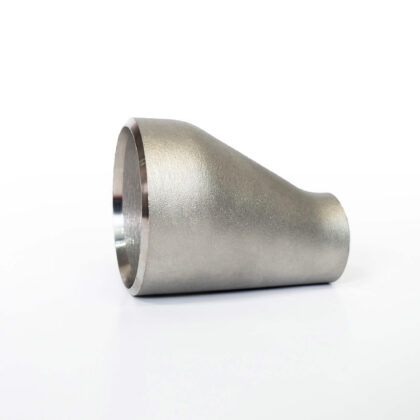
Seamless eccentric reducers and their role in professional piping systems
In the world of process engineering, the simplest path is not always the best one. While symmetry is often the goal, in pipeline design, we frequently encounter situations where axial alignment becomes an obstacle. This is exactly when seamless eccentric reducers step onto the stage. These specific fitting components allow for a change in pipe diameter in such a way that one of its edges – usually the bottom or the top – remains in a straight line. The seamless design, meaning the element is manufactured from a single piece of steel, guarantees the highest level of tightness and resistance to extreme operating conditions here.
Why even bother with an asymmetrical shape? Imagine a pipeline transporting liquid where air bubbles could accumulate, or a drainage line where sediment must encounter no barriers. An eccentric reducer, thanks to its “flat” side, allows for complete drainage of the pipe or free flow of gases, which would be impossible with standard solutions. It is a small change in geometry that determines whether the entire installation will operate smoothly or become a source of endless technical problems.
Choosing a seamless version is a declaration of commitment to quality without shortcuts. The homogeneous structure of the material, devoid of a longitudinal weld, withstands vibrations and sudden pressure surges much better. In modern industry, where every minute of downtime counts, such details are of colossal importance. The smoothness of the internal walls additionally minimizes turbulence, which directly translates into lower energy consumption by the pumps moving the medium.
Application of asymmetrical reducers in industrial practice
Seamless eccentric reducers are an absolute foundation in industries where precision meets rigorous safety standards. They are most commonly found on pump suction lines – they are installed with the flat side up to prevent the accumulation of air, which could lead to dangerous cavitation and the destruction of expensive equipment. This is a classic example where the shape of a component directly protects the heart of the entire system. Conversely, in horizontal pipelines, installing them with the flat side down facilitates drainage and system cleaning, which is crucial in the food and chemical industries.
The pharmaceutical and biotechnology industries also cannot imagine working without these components. Where sterility is a priority, seamless reducers made of acid-resistant steel help avoid dead zones where microorganisms could grow. But we don’t have to look that far – HVAC systems, shipbuilding, or even advanced district heating installations benefit from asymmetrical transitions to optimally manage limited space in technical ducts.
It is also worth mentioning the power and offshore sectors. On drilling platforms or in power plants, where installations are constantly exposed to external factors, the durability of the seamless version is invaluable. These reducers perform perfectly in places with difficult service access – once installed, they serve for decades, requiring no frequent weld inspections, which they simply do not have.
Steel grades and technical parameters of materials
At stalesia.com, we know that steel is not just a chemical symbol; it is primarily about specific physical properties tailored to your needs. Our seamless eccentric reducers are available in grades that have become a standard in professional engineering. One of the most frequently chosen is 1.4541 steel (also known as AISI 321). Thanks to the addition of titanium, this material is characterized by excellent resistance to intergranular corrosion, making it an ideal choice for operation at elevated temperatures.
For more demanding environments, we have prepared elements made of 1.4571 (AISI 316Ti) acid-resistant steel. This is a true “tough guy” among alloys – the addition of molybdenum makes the reducer resistant to chlorides and aggressive acids. It is the number one choice in the chemical industry and wherever the installation comes into contact with seawater. Using these grades ensures that the pipeline does not “give in” to time and corrosive factors.
We often encounter questions about the differences between austenitic and ferritic steel. In our offer, we focus on austenitic grades due to their extraordinary ductility and ease of butt welding. These are materials that “work” together with the installation, forgiving minor mechanical and thermal stresses. Each reducer has clear markings, allowing for quick identification of the material batch and compliance with project documentation.
How to correctly select and install an eccentric reducer
Selecting the right component is a process that requires attention on several levels. The first step is always the analysis of connection diameters – we must precisely know the outer dimension and wall thickness of both pipes being joined. In the case of seamless reducers, the manufacturing precision is high enough that the transition between diameters occurs smoothly, minimizing flow resistance. Remember that every change in direction or cross-section is a potential point of energy loss, which is why using components with proven parameters is so important.
Another issue is the installation orientation. Do you need a flat top or a flat bottom? This depends on whether your priority is to avoid air pockets or perhaps ensure free liquid drainage. Before purchasing, it is worth consulting the technological design, as an error in this regard can affect pump efficiency or complicate the Cleaning in Place (CIP) process.
If you are planning an installation that will work under high pressure, a seamless reducer will be a bullseye. The absence of a circumferential weld eliminates the risk of fatigue cracks in the heat-affected zone, which is a common problem in cheaper, welded substitutes. Our technical team at stalesia.com is always ready to advise – we know that every project is different and sometimes a small detail, like the choice between 1.4541 and 1.4571 steel, can determine the success of the entire investment.
Is your pipeline ready for new challenges? We invite you to explore the full specification of our eccentric reducers. Whether you are building a modern production line in the food industry or modernizing systems in a chemical plant, we will provide you with components you can rely on. Check availability and technical parameters now – your installation deserves the best solutions.
Perhaps you would also be interested in other seamless fitting elements to complete your order? We will be happy to help you put the whole set together.
Eccentric Reducers by steel grade
Pick a grade to see only eccentric reducers in that material – with the full list of sizes and a description of the steel. The number next to each grade is the count of items in stock.
Acid-resistant
Austenitic with molybdenum – resistant to pitting and crevice corrosion; for chemicals, processing and chloride environments.