
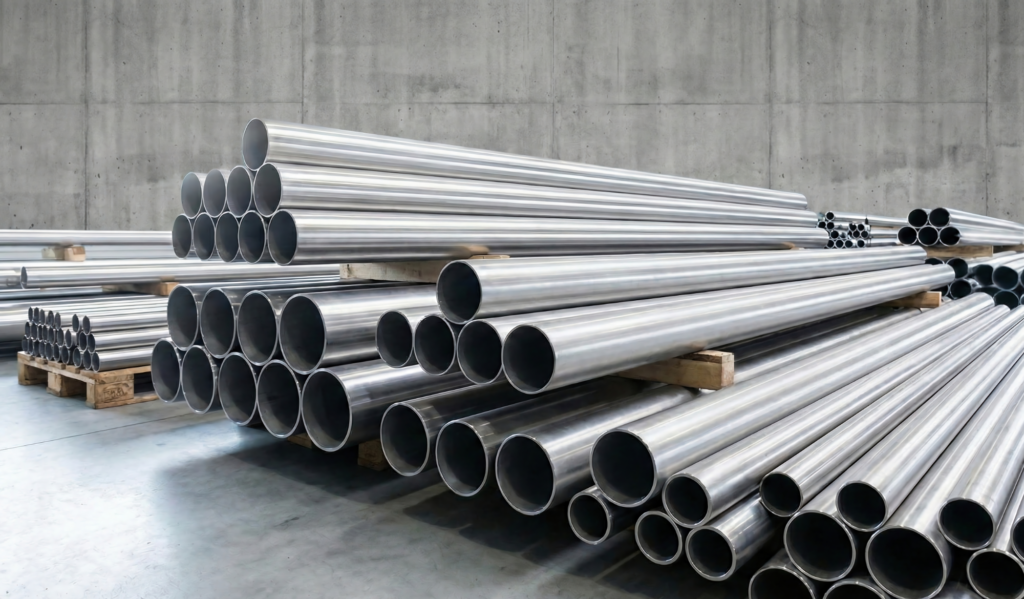
In a stockyard, two pipes can look identical: the same shine, the same diameter, almost the same price per metre. One is grade 1.4301, the other 1.4404. You cannot see the difference with the naked eye, yet it can decide whether an installation lasts for years or starts to corrode after its first season in contact with brine. So how do you tell “acid-resistant” steel from ordinary stainless?
First, a word about names
Formally, both are stainless steels – EN 10088 does not recognise “acid-resistant steel” as a term. In Poland, though, the trade commonly splits stainless into two groups, and we explain where that comes from in Stainless or acid-resistant steel? In workshop and trade usage, “ordinary stainless” usually means chromium-nickel steel of the 304 type (1.4301, 1.4307), and “acid-resistant” means molybdenum-bearing steel of the 316 type (1.4401, 1.4404, 1.4571). That is the convention used in the rest of this article.
What really separates them – molybdenum
The difference comes down mainly to one element. According to EN 10088, grade 1.4301 contains 17.5–19.5% chromium and 8–10.5% nickel, and no molybdenum at all. Grade 1.4404 has slightly less chromium (16.5–18.5%), more nickel (10–13%) and 2–2.5% molybdenum.
Molybdenum strengthens the passive layer where it is most vulnerable – in the presence of chlorides. That is why 316-type steel copes much better with seawater, road salt, pool water, chlorine-based disinfectants and many of the acids used in the food and chemical industries. The PREN, used to compare resistance to pitting corrosion, shows this clearly.
| Property | 1.4301 (304) | 1.4404 (316L) | 1.4571 (316Ti) |
|---|---|---|---|
| Chromium | 17.5–19.5% | 16.5–18.5% | 16.5–18.5% |
| Nickel | 8–10.5% | 10–13% | 10.5–13.5% |
| Molybdenum | – | 2–2.5% | 2–2.5% |
| Carbon (max.) | 0.07% | 0.03% | 0.08% |
| Stabilising addition | – | – | titanium |
| PREN (approx.) | 18–20 | 23–28 | 23–27 |
What you cannot see with the naked eye
The surface tells you nothing about the grade. Shine, grit finish and tone depend on the finish – 2B, BA, K240 grinding – not on the chemical composition. Weight won’t help either: the densities of the two steels differ by about 1%, which you cannot feel in a stockyard.
The magnet test – what it shows and what it doesn’t
The popular magnet test separates austenitic steels from ferritic and martensitic ones, but it does not separate 304 from 316. Both 1.4301 and 1.4404 are practically non-magnetic in the solution-annealed condition. A magnet will, however, attract ferritic steels such as 1.4016 and martensitic steels such as 1.4021.
There is a catch. After cold forming – bending, drawing, rolling – grade 1.4301 can become slightly magnetic, because part of the austenite transforms into strain-induced martensite. Grade 1.4404 has a more stable structure and is less affected. So a slight pull on an elbow or a drawn tube does not mean it is “ordinary steel” or a fake.
The molybdenum spot test
The simplest workshop method is a molybdenum detection reagent. A drop of reagent is applied to a cleaned surface – some kits assist the reaction with a small electric current – and a colour change indicates molybdenum. The test is cheap and fast, but it has its limits: it tells steel with molybdenum from steel without it, it does not give the content, and it cannot tell 1.4401, 1.4404 and 1.4571 apart.
XRF analysers and spectrometers – a definite answer
Plants and laboratories use handheld X-ray fluorescence (XRF) analysers for PMI (Positive Material Identification). In a few seconds, and without damaging the part, they show the content of chromium, nickel, molybdenum or titanium, so they easily tell 1.4301 from 1.4404 and 1.4571.
XRF does not measure carbon, however. To tell a low-carbon version (1.4404, 316L) from a standard one (1.4401, 316), you need an optical emission spectrometer (OES) or a laboratory analysis. This matters above all in welding – see our guide to welding stainless steel.
The most reliable source: marking and inspection certificate
Before reaching for reagents, check the markings and the paperwork. Mill pipes, bars and sheets are usually marked – the print or stamp gives the grade, standard, size and heat number. The heat number links the item to a 3.1 inspection certificate to EN 10204, in which the producer states the actual chemical composition and mechanical properties of the batch.
If the material is going somewhere the grade matters – the food, pharmaceutical or chemical industries, or structures by the sea – it is worth ordering the 3.1 certificate straight away. In our shop it can be added to an order as a paid extra. Also look out for multi-grade designations such as “1.4401 / 1.4404 / 316 / 316L” – we explain them in which grade do you actually get?
When do you need 316, and when is 304 enough?
- 1.4301 / 1.4307 is usually enough for interiors, kitchen and catering equipment, indoor railings, drinking water installations and most food industry applications without brine or chlorides.
- 1.4404 / 1.4571 is worth choosing for contact with chlorides (seawater, road salt, swimming pools), disinfectants, organic acids, the chemical and pharmaceutical industries, and outdoor parts near the sea or near roads treated with salt.
- Higher still: in very aggressive environments – high chloride concentrations combined with elevated temperature – duplex steels such as 1.4462 are used.
When choosing, it is worth weighing the difference in material price against the cost of replacing a part that has started to corrode.
Summary
You cannot tell 316 from 304 by eye, by weight or with a magnet. A magnet will at most separate austenitic steels from ferritic and martensitic ones, a spot test will reveal molybdenum, and an XRF analyser will give the chemical composition apart from carbon. The most reliable source remains the material marking and a 3.1 certificate with the heat number.
Not sure which steel grade is right for your application?
Contact us – we will help you choose a material for the real operating conditions.