
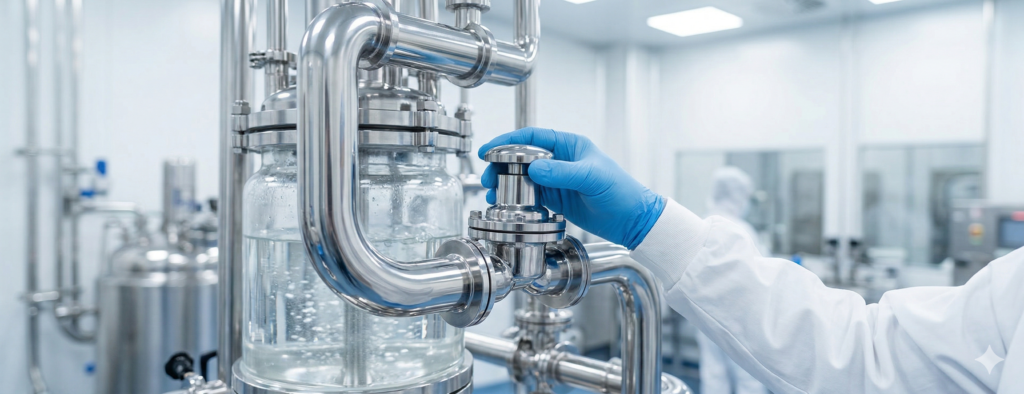
Imagine a place where the smallest speck of dust, a bacterium invisible to the naked eye, or a trace amount of cross-contamination could mean a catastrophe worth millions of euros. We are talking about laboratories and production halls of the pharmaceutical industry, where life-saving medicines and health-maintaining supplements are produced. In this sterile world, where white coats and masks are the norm, one material reigns supreme, one that does not tolerate errors and guarantees the highest level of safety. Stainless steel is the silent hero behind every pill you take from a blister pack. Without it, modern medicine simply could not operate on the scale we know today.
Listen, this is not just a matter of “nice appearance” or easy floor cleaning. In pharmaceuticals, steel is the foundation on which patient trust in the product is built. Every reactor, every pipeline, and every smallest component of the installation must meet stringent standards that sound like black magic to the average person. There is no room here for “it will do” or cheap substitutes. The material must be chemically inert so as not to react with the ingredients of medicines, while simultaneously being durable against aggressive disinfectants. It is the true Formula 1 among construction materials, where every micron and every second of trouble-free operation counts.
Absolute Cleanliness – Standards That Allow No Compromise
In the pharmaceutical industry, hygiene is not just an empty slogan; it is a religion supported by strict GMP (Good Manufacturing Practice) regulations. To ensure medicines are safe, all stainless steel fittings used in the production process must be designed to avoid so-called dead zones. These are areas where product residues or bacteria could accumulate and cannot be flushed out during standard cleaning. Listen, this is an incredibly challenging engineering task – to create a system of pipes and valves that is perfectly smooth and unobstructed in every inch.
That is precisely why these installations are dominated by specialised electro-polished pipes. This process makes the internal surface of the metal as smooth as an ice sheet on a sunny day. Thanks to this, active substances flow freely through the system, and the risk of anything “sticking” to the wall is practically zero. This is crucial when it comes to serial production, where after one batch of medicine, the line must be perfectly cleaned before starting the next. Every scratch or indentation is a potential hideout for microorganisms, and no one in pharmaceuticals can afford that.
It is also worth knowing that the stainless steel used in this sector must have certificates confirming its origin and chemical composition. It is not enough that something “does not rust”. The material must be resistant to intergranular corrosion and pitting corrosion, which we have discussed in other contexts. Pharmaceuticals is an environment where technology meets the highest attention to detail, and stainless steel is the only material capable of meeting these demands through years of intensive use. It is safety that knows no price because the stakes are human lives.
Surface Roughness – Why Microns Matter
When you touch a steel countertop with your finger, it seems perfectly smooth. However, in the pharmaceutical world, this is just an illusion. Under a microscope, ordinary steel looks like a mountain range full of valleys and peaks where bacteria can feel like they are in a five-star hotel. Therefore, the parameter that keeps quality controllers awake at night is surface roughness, denoted by the symbol Ra. The lower the Ra value, the fewer “nooks and crannies” the metal has. In the most demanding processes, such as the production of intravenous drugs, standards require the surface to be as smooth as physically possible.
Achieving such an effect requires time and specialised equipment. Electro-polished pipes are not products you can buy in every hardware store. These are premium metallurgical products that undergo acid baths under electrical voltage to remove even the smallest surface irregularities. Thanks to this, cleaning the installation becomes much more effective. Imagine the difference between cleaning a rough brick and a smooth glass pane – this is exactly the analogy that determines the speed and effectiveness of disinfection in a pharmaceutical factory.
Low surface roughness also has another very practical dimension. It allows for a significant reduction in water and detergent consumption during CIP (Cleaning-in-Place) processes. This is automatic cleaning of the installation without the need for dismantling. The smoother the stainless steel, the less aggressive chemicals are required to remove deposits. This, in turn, translates into longer service life of the entire system and a smaller environmental impact. It is economy and ecology combined, dressed in a shiny, metallic form that guards the cleanliness of our medicines.
Stainless Valves and Food-Grade Pipes Serving Medicine
The term food-grade pipes is often heard in the context of the pharmaceutical industry. Although these sectors differ, they share an obsession with hygiene. In pharmaceuticals, however, we go a step further. Transmission systems must be not only clean but also completely microbiologically sealed. Here, stainless steel valves with a special membrane design play a key role. Unlike ordinary ball valves, they have no places where fluid residues could accumulate. Every valve movement guarantees that the process proceeds in full isolation from the environment.
Designing such systems is a true challenge for engineers. All components must be connected using orbital welding, which guarantees a perfectly smooth fusion inside the pipe. Any weld flash is a death sentence for the sterility of the system. Therefore, stainless steel fittings for pharmaceutical applications are manufactured with extraordinary precision, and every batch of goods is inspected for tightness and finishing quality. These are the standards that make medicines produced in Europe considered the safest in the world.
We must also not forget that acid-resistant steel in laboratories must cope with SIP (Sterilization-in-Place) processes. This involves blowing through the installation with superheated steam at temperatures exceeding 120 degrees Celsius. Only stainless steel can withstand such cyclic thermal shocks without deforming and without the risk of weld cracking. This durability goes hand in hand with design flexibility, allowing the construction of production lines that occupy entire factory floors and operate with the precision of a Swiss watch.
Dosing and packaging systems – where every detail matters
Once the medicine is ready, it must be precisely measured and packaged. Here, noble steel again demonstrates its superiority. All dosing needles, capsule feeders, or packaging machine components are made from metal that does not release any ions into the product. Imagine if the needle filling the ampoule could alter the chemical composition of the medicine – that would be unacceptable. Therefore, the highest-grade steel is used in these areas, often additionally hardened to prevent wear during millions of operating cycles.
Precise stainless steel in packaging systems must also be resistant to electrostatic phenomena. Many powdered medicines tend to “stick” to machine walls under the influence of electric charges. Properly grounded steel installations eliminate this problem, ensuring smooth production flow and dosing accuracy. These are details that patients never think about when swallowing a tablet, but they are precisely what determines whether each pill contains exactly the amount of active substance declared by the manufacturer on the packaging.
In summary, the marriage of pharmacy and stainless steel is one of the most successful unions in industrial history. It is a partnership based on strict principles, where sterility, durability, and precision are the only acceptable parameters. Without solutions such as electrochemically polished pipes or advanced stainless steel fittings, the mass production of safe medicines would simply be a pipe dream. Stainless steel is the foundation of modern health, a material unafraid of challenges and one that every day, in thousands of factories worldwide, stands guard over our safety. It is proof that true quality does not need advertising – it defends itself in every pure ampoule and every safe syrup.