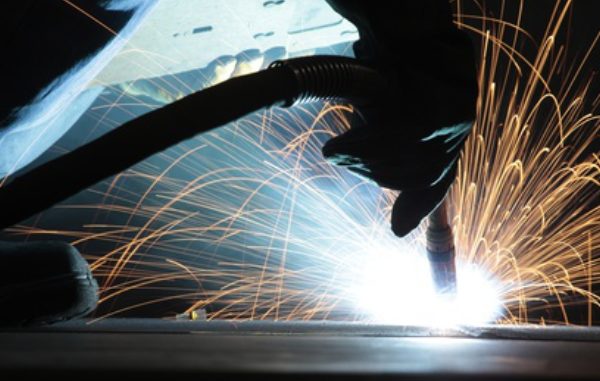
The choice of welding method depends on the composition of the stainless steel, while the type of flux chosen affects the quality of the weld. The best results can be achieved by selecting the appropriate welding method, which depends on many factors, e.g. the intended use of the product itself. Several methods are commonly used for welding stainless steels.
One of them is gas metal arc welding (Eng. Gas Metal Arc Welding – GMAW) where the main advantage is the speed of joining due to the use of a spool of solid wire or a flux-cored spool. However, it should be remembered that the main drawback of this method is the high cost of the equipment that feeds the wire, the electrical connections, and the gas shielding. The absence of slag formation or its small amount means there is no need to remove it between electrode passes. A wide range of heat input and process speed is achieved by welding with solid wire or flux-cored wire in three ways: globular (gravity) transfer, short-circuit transfer, and spray transfer. Of these three, globular transfer is the least used with stainless steels, while spray transfer works well for thinner sections and for welding misaligned (offset) parts, whereas short-circuit arc welding is commonly used to join thin stainless steel tubes and sheets.
In the mentioned GMAW method the primary required factor is the gas shield, which prevents oxidation of the steel alloys in the arc. A small admixture of oxygen can significantly improve arc stability, but then losses of aluminum or titanium may occur. Any spatter is unacceptable for the quality of the weld itself and can occur in the GMAW method; nevertheless, recent solutions referring to short-arc welding have significantly reduced this problem.
Gas tungsten arc welding in an inert gas shield (Eng. Gas Tungsten Arc Welding – GTAW) allows obtaining relatively high-quality, clean welds with a small number of defects. This method is used wherever strict standards and regulations must be observed, e.g. in the food or nuclear industries, but it is more time-consuming than the GMAW method mentioned above. To achieve clean welds on stainless steels containing aluminum, alternating current is used or, more commonly, direct current with electrodes of negative polarity supplied with direct current.
Another method is shielded metal arc welding (Eng. Shielded Metal Arc Welding – SMAW) used for repairs or wherever welding is not needed frequently. The SMAW method is applied in the production of stainless steels where the equipment needed to perform the weld is among the cheapest. Generally, four basic types of covered electrodes are used here to weld stainless steel: basic, rutile, rutile-silicate, and heavy-coated electrodes for vertical-down and horizontal welding. The welding position essentially influences the choice of electrode.
Submerged arc welding (Eng. Submerged Arc Welding – SAW)
This welding is characterized by intensive interaction between the wire and the flux accompanied by chemical exchange of elements. It is most often used when joining thicker austenitic stainless steel components, typically with a thickness above 12 mm. SAW is suitable wherever there is no pressure for rapid solidification of the weld and where there are greater possibilities for heat input.
As can be seen, each of the above methods finds its application at various stages of production, processing and use of stainless steels in the broadly understood metallurgical products industry.