
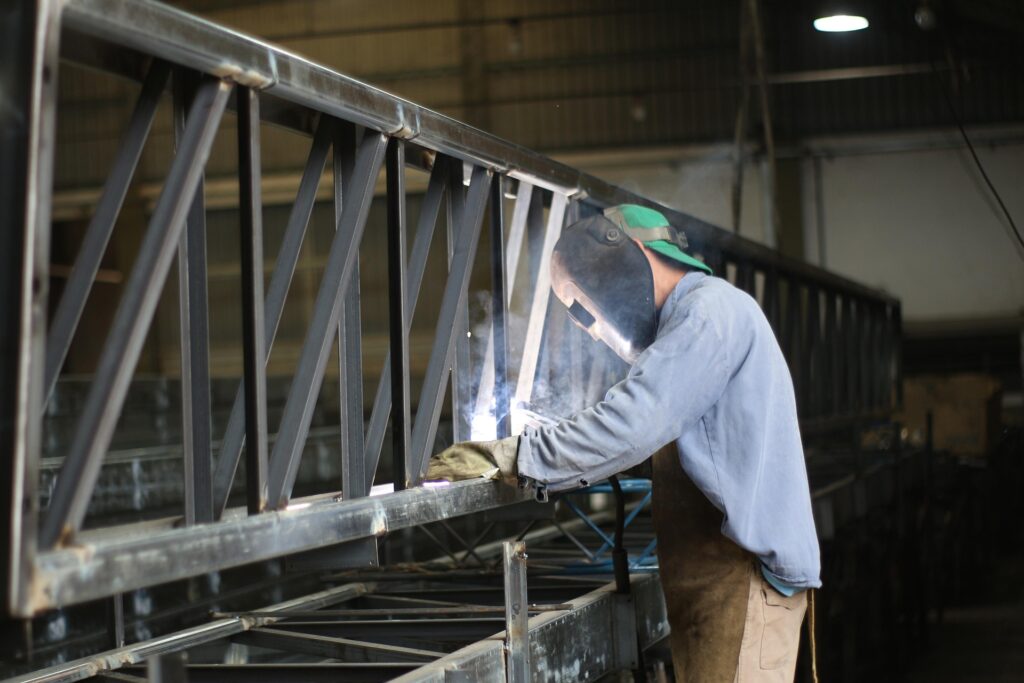
Welding stainless steel is, for many hobbyists and even professional welders, a true test of patience and precision. Let’s not beat around the bush – it is not the same as joining ordinary “black” steel, where mistakes can sometimes be concealed with a thicker layer of paint. Stainless steel is like a capricious artist: if you approach it with respect and the right knowledge, it will reward you with a weld that will shine for decades. However, if you neglect the rules, you will quickly realise that your supposedly indestructible structure begins to “cry” rust exactly where the electric arc failed. Listen carefully, welding stainless steel is a process where chemistry meets physics in a very intense way, and our task is to control this chaos so that the metal does not lose its magical anti-corrosion properties.
Many beginners ask themselves: why is it so difficult? The answer lies in the thermal conductivity and expansion of the metal. Stainless steel conducts heat much worse than carbon steel, which means that the energy you introduce during welding remains “trapped” in one place. This leads to enormous stresses and deformations. If you have ever seen a straight pipe bend into a banana shape after placing a single weld, you already know what I mean. Understanding how to manage temperature is the first step to success, without which even the most expensive welding machine will not make you a master craftsman.
Another aspect is protection against oxygen. Stainless steel hates air during welding as much as a diver hates a hole in their suit. Oxygen at high temperatures instantly destroys the chromium layer responsible for the material’s stainless properties. That is why professional stainless steel welding requires not only shielding gas in front of the torch but often also so-called backing gas protection, which involves introducing gas inside the joined elements. This is a fundamental principle often forgotten by amateurs, who then wonder why their acid-resistant steel starts to corrode from the inside of the pipe.
TIG or MIG? The Choice of Method Matters for Your Project
The choice of welding method often depends on what you want to achieve – speed or aesthetics. The TIG (Tungsten Inert Gas) method is the absolute queen when it comes to noble steel. It allows incredible control over the weld pool, which is crucial for thin elements such as decorative pipes or delicate stainless steel accessories. TIG welding is somewhat like painting with a brush – it requires both hands, concentration, and produces welds so clean and aesthetic that they often require almost no mechanical finishing. It is the ideal solution for balustrades, loft furniture, or installations in the food industry.
On the other hand, the MIG/MAG method is the choice for those who need to weld kilometres of seams on thick materials. It is much faster but requires more skill in setting parameters to avoid spatter. When welding with MIG, we use a special welding wire that must be perfectly matched to the grade of steel being joined. You cannot use just any wire – if you are welding 316 steel, the wire must have the appropriate molybdenum content so that the weld does not become the weakest link in the fight against a corrosive environment. This is where errors most often occur, affecting the durability of the entire structure, from stainless profiles to large industrial tanks.
It is also worth mentioning the MMA method, i.e., shielded metal arc welding. Although it may seem somewhat old-fashioned, it still has its place, especially in fieldwork where wind could blow away the shielding gas. Modern electrodes for stainless steel allow very good results, although they require laborious slag removal afterwards. Regardless of the chosen method, remember that the welding machine is only a tool – it is your hand and eye that decide whether the weld will be safe and durable.
Cleanliness Is Fundamental – Why Stainless Steel Does Not Forgive Dirt
If you thought that wiping the metal with your sleeve before welding was enough, I have bad news for you. Stainless steel is incredibly demanding in this respect. Every trace of grease, fingerprints, dust from ordinary steel, or even glue residue from a label can ruin the weld. During welding, these contaminants burn, introducing carbon and other elements deep into the metal, leading to so-called intergranular corrosion. Listen, this is no joke – cleaning is half the success in welding.
The most important rule is tool segregation. Never, ever use the same wire brush for black steel and stainless steel. Particles of ordinary iron embedded in the surface of stainless steel are a death sentence for corrosion resistance. Always have a separate set of brushes (necessarily stainless steel!), grinding discs, and files that will only touch noble materials. Even the welding table should be covered with a clean sheet or copper plate to avoid “infecting” our stainless steel with rusting scale.
Before striking the arc, it is worth wiping the edges with a special acetone-based cleaner. This removes residues of coolants from the cutting process or grease from your hands. Professionally prepared stainless steel fittings look like works of art after welding. Attention to such details distinguishes a hobbyist from a true professional for whom the quality of the material, such as stainless pipes or sheets, is a sacred matter. Cleanliness is not about aesthetics; it is a necessary condition for the steel to remain “stainless” also at the joint.
Shielding Gas and Backing Gas – The Invisible Heroes of Welding
Most people focus on what they see – the arc, the wire, the welding mask. But what is invisible, namely the shielding gas, does the lion’s share of the hard work. In the case of TIG welding, pure argon is the standard. It must be of the highest purity, because even the smallest admixture of oxygen or moisture will cause oxidation of the weld, which will take on an unsightly black colour. A properly welded stainless steel should have a straw, golden, or slightly violet colour. If it is grey or black, it means the metal has been “burnt” because there was too little gas or it was contaminated.
However, there is something even more important that many forget: root protection. When welding stainless steel pipes, the shielding gas protects the weld from the outside, but what happens inside the pipe? There, oxygen has free access and at high temperatures it destroys the metal from within, creating the so-called “cauliflower”. This is a porous, brittle structure that rusts rapidly and traps all impurities. In the food or pharmaceutical industry, such a weld is a one-way ticket to the closure of the plant by the sanitary inspection. Therefore, the pipe must be sealed and filled with argon (or a special forming gas mixture) from the inside.
This is a time- and gas-consuming process, but absolutely essential if you are building pressure installations or those in contact with food. Even if you are making a balustrade for a house, root protection will ensure that the structure is much stronger and will not start to rust from the inside after the first damp night. It is an invisible detail that separates professionalism from shoddy workmanship. Remember – gas is not a cost, it is an investment in the durability of your work.
The most common mistakes that “kill” the stainless quality of the weld
One of the most frequent sins is overheating the material. Stainless steel has a low melting point and – as I have already mentioned – conducts heat poorly. Too high a welding current or moving the torch too slowly causes chromium burnout. If after welding you see a wide, dark band around the weld, it is a sign that you have overdone the temperature. Such acid-resistant steel ceases to be acid-resistant precisely at that spot. To avoid this, weld in short sections, allowing the metal to cool down, or use special cooling pastes.
Another mistake is the lack of proper finishing after welding. Every weld, even the neatest, requires pickling and passivation. During welding, the natural protective layer of the steel is disturbed. Professional chemical agents remove oxygen discoloration and help the steel rebuild its anti-corrosion “shield”. Ignoring this stage is inviting trouble. Even if the weld looks healthy, without passivation it will be much more susceptible to chemical attacks or road salt. It is like going out into the cold without a jacket – you can do it, but you will feel the consequences very quickly.
Finally, I will mention the selection of filler materials. Welding stainless steel with ordinary carbon steel wire is a cardinal mistake that happens more often than you think, especially in small workshops. Such a weld rusts before your eyes and is extremely brittle. Always check the markings on the wire or electrodes. Metallurgical products require dedicated welding chemistry. If you have stainless profiles of a specific grade, make sure that your filler material is of a higher grade or at least the same. Thanks to this, your work will withstand the test of time and will be a source of pride, not costly repairs.