
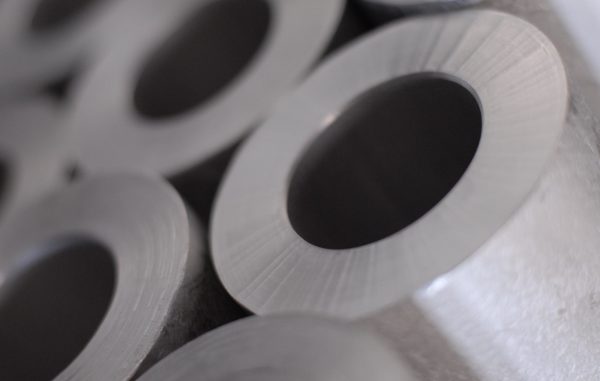
The grade designated (according to the European standard) as EN 1.4571 is the stainless steel type 316Ti. It can be described as the basic 316 (1.4401) steel grade with a stabilizing additive. That additive is titanium. The role of titanium in this steel is fundamental. It is of particular importance during heating of the product to a maximum temperature of 815°C. With the addition of titanium, the risk of intergranular corrosion is reduced. Titanium together with carbon forms appropriate carbides that prevent the formation of chromium carbides. As a result, the chromium concentration remains constant – preventing intergranular corrosion.
What is intergranular corrosion (intergranular corrosion)?
It occurs when a solution attacks grain boundaries without damaging the grain interiors. It is, in other words, the selective dissolution of grain boundaries or adjacent areas as a result of the corrosive process. The factor triggering this process is the potential difference between a Cr (chromium)-depleted grain boundary in the case of chromium carbides – the anode, and an inclusion, intermetallic phase, or impurities forming at the grain boundary. It depends on the chemical composition and heat treatment. This corrosion progresses from the surface into the metal. Strength and ductility then decrease sharply. A sample of material affected by such corrosion does not emit a metallic sound, and during bend tests – it cracks. In extreme cases it can disintegrate into powder. This type of corrosion is very dangerous. Determining the exact degree of advancement of this corrosion is very difficult. Assessment of this corrosion is carried out through microscopic examinations and by measuring the increase in electrical resistance.
There is also another way to counteract intergranular corrosion. It is to radically reduce the carbon content in the steel. This reduction reaches even down to the level of 0.03%. In this way another steel grade was created – designated as 316L (1.4404). Compared to the base grade 316 (1.4401) its carbon content has been significantly reduced. Thanks to these measures, steels 316Ti and 316L are characterized by increased resistance to intergranular corrosion.
Titanium contained in the 316Ti grade steel (EN 1.4571) increases mechanical performance at high temperatures, above 590 °C. Therefore, wherever the service environment is exposed to high temperatures, using steel of grade 1.4404 is not fully justified. Conversely, in a room-temperature working environment, grade 1.4571 shows lower formability than steel 1.4404. Additionally, grade 316Ti is more difficult to polish and has lower machinability than 316L. This is related to the presence of titanium carbonitrides in 1.4571. The weldability of both steel grades (316Ti and 316L) is similar. Differences in this area are not very noticeable.
Stainless steels 1.4404 and 1.4571 have been tested at very low temperatures. The results indicate that both grades can be used in cryogenics, because high impact toughness is required there. At temperatures below 200 °C it is recommended to use low-carbon steel grades such as 1.4301 and 1.4404.
In contrast to conventional austenitic steels, duplex and super duplex steels exhibit much higher tensile strength. It is usually about twice as high as the yield strength, whereas for austenitic steels this ratio is only about 0.35. This comparison favors duplex steels, because for designers the primary design parameter is the yield strength. When working at elevated temperatures, one must expect a decrease in yield strength due to the weakened strengthening effect of nitrogen. This happens because nitrogen atoms dissolved in austenite become more mobile and therefore are less able to block dislocation motion.