
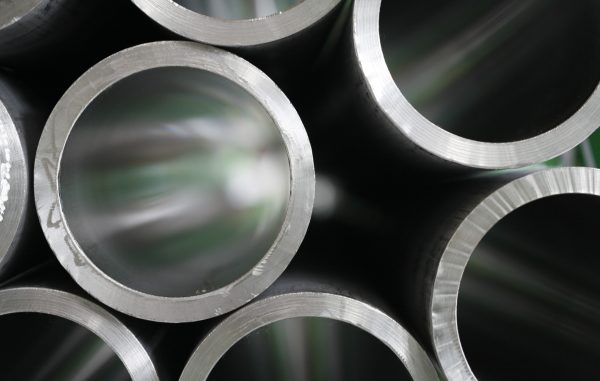
Classification by pipe end finish
Different applications of steel pipes call for different finishing of their ends. The following types can be distinguished:
- pipes with threaded ends: pipe thread (Whitworth or Briggs), drill pipe thread (Briggs),
- pipes with plain ends – the largest group, because most joints are welded,
- pipes with socket ends – used less and less, mainly for line pipes,
- pipes with flared collars for loose flanges – also used less and less, as welding has become universal.
The most common steel pipe dimensions
The basic dimensions of a steel pipe are its outside diameter and wall thickness. Both are standardised according to the pipe’s purpose and production technology. The inside diameter follows from these two.
Pipe sizes follow an established system in which outside diameters are linked to a range of wall thicknesses. The whole has to suit the intended purpose, and the economics of producing and using the pipes are taken into account as well.
Line pipe dimensions were the first to be systematised. Other types of pipe followed them, because they were made on the same machines.
In Great Britain, the range of line pipe sizes was put in order after the introduction of the Whitworth thread, with its 55° thread angle. Pipes in Europe are still specified according to the rules introduced in Britain.
In the USA, the standards of the American Petroleum Institute were adopted. Line and drill pipes were put in order based on the Briggs thread, with a 60° thread angle. API drill pipes have been adopted worldwide.
In Poland, the range of diameters for pipes intended for threading was based on the Whitworth thread, and wall thicknesses are chosen so that a thread can be cut. Because of the forces needed to cut the thread and make up the joint, threaded connections are not used in Poland for diameters above 4″ (equivalent to DN100).
Classification by cross-section
By cross-sectional shape, pipes can be divided into:
- round,
- rectangular,
- square,
- polygonal,
- elliptical,
- teardrop,
- other.
By wall design, the following types are distinguished:
- constant wall thickness,
- variable wall thickness,
- pipes with extruded external fins,
- pipes with extruded internal fins,
- rolled or extruded fins (straight, pin, spiral),
- fins wound from strip and welded on.
Classification by protective surface coating
The vast majority of pipes are produced without a protective coating. This group includes black and bright pipes.
Black pipes are the widest range produced. Their surface is covered with a thin layer of oxides – mill scale – and a thin film of rust may also be present. They are protected against corrosion once the installation is complete, or they work without paint at all, as boiler tubes do because of the temperatures involved.
Bright pipes are most often structural tubes with high surface quality requirements. They are cold-worked; heat treatment is possible in a protective atmosphere, but they need cleaning afterwards. Bright pipes may be coated with protective grease.
Depending on the type of protective coating, there are two kinds of pipe:
- pipes with metallic coatings – mostly galvanised pipes used in hot and cold water installations. Such pipes are exposed to the corrosive action of water and are often given a double zinc coating. Coatings of other metals are also used, particularly for pipes intended for industry,
- pipes with non-metallic coatings – enamelled, lacquered or asphalt-coated. Enamelled pipes are used mainly in the chemical industry. Asphalt-coated pipes usually have large diameters and are used for long-distance water, gas and oil pipelines.
There are also lined pipes, with ceramic or plastic (rubber, PVC) linings, and clad pipes, covered with a layer of highly resistant metal. Ceramic or rubber linings are needed where pipes are subject to heavy abrasion, for example when conveying a mixture of water and quartz sand. Clad pipes and plastic-lined pipes are used above all in the chemical industry. They reduce the consumption of corrosion-resistant steels, lower installation costs and extend service life.
Classification by manufacturing technology
In terms of manufacturing technology, there are two main groups of steel pipes: seamless and welded. Each group is further characterised by its production method – hot or cold.
Seamless pipes are rolled or drawn, hot or cold. They can be produced in diameters up to 508 mm. Seamless pipes of 500–800 mm are rarely made, and above 800 mm only welded pipes are available. This is because demand for large-diameter seamless pipes is small, while welded pipe technology keeps improving.
Hot-rolled or hot-drawn pipes have a minimum outside diameter of 20 mm. They have lower dimensional accuracy and a poorer outer surface.
Cold-rolled or cold-drawn pipes cover a smaller range of outside diameters, from 3 mm to about 200 mm. On the other hand, they can have thinner walls than hot production allows. They offer much higher dimensional accuracy and surface quality, and cold work can also give them better mechanical properties.
Welded pipes can be divided by production technology into electrically welded pipes (resistance or induction welding) and fusion-welded pipes, e.g. arc-welded under an argon or hydrogen shield.
Longitudinally welded pipes have small diameters, while spirally welded pipes are made in large diameters. Welded pipes may undergo further forming, or have the weld flash removed, as with resistance-welded pipes.
The beginnings of steel pipe production
Until the 19th century, pipes were made mainly from soft, malleable metals – above all lead. The first major impulse for developing steel pipe technology was the world’s first gas lighting installation, built in London around 1815, after the Napoleonic Wars. It was made of musket barrels joined with threaded connections. The tapered shape of the barrel allowed an external thread to be cut at the thinner end and an internal one at the thicker end, by the breech. The bore of the pipeline was about half an inch. The need to extend it, and to build new ones in other parts of London and in other cities, caused a sharp rise in demand for steel pipes.
Production of butt-welded pipes with outside diameters up to 76 mm was patented in Britain in 1825. The patenting of lap-welded pipes in the same country in 1842 made it possible to produce pipes with outside diameters up to 305 mm.
Britain also pioneered thread standardisation. In 1841, a pipe thread standard was drawn up for lap-welded pipes which, with minor modifications, still applies in many countries today. The thread is named after the man behind the standard and is widely known as the Whitworth thread. The pipe diameters associated with it are still used in Europe for threaded installation pipes.
In the USA, threads and pipes were standardised somewhat later, in 1862, when the thread still used today under the name of the Briggs thread was introduced.
Classification of steel pipes by application
Depending on the parameters that matter, pipes are classified by, among other things:
- application,
- production method,
- cross-sectional shape,
- type of protective layer and surface quality,
- end finish,
- the steel grade they are made from,
- scope of acceptance testing,
- manufacturing accuracy.
| Line pipes | Structural tubes | Heat exchanger tubes | Drill pipes | |
| Coal mining (backfill pipelines) | Steam, water, air, gas and oil pipelines, etc. | Aerospace | Boiler tubes | Pump pipes |
| Mechanical engineering (lines) | Short-distance pipelines: (construction, power generation, chemical industry, mining) | Automotive | Tubes for chemical and process equipment | Casing pipes |
| Long-distance pipelines (oil, gas and water transport) | Furniture | Refrigeration | Washover pipes | |