
Anyone who has spent a holiday by the open sea is well acquainted with that distinctive, bracing scent of the air, mingling with the sound of waves and the cries of seagulls. For us, it is the quintessence of relaxation, but for metal, it signals a true battle for survival. The salty breeze, although beneficial for our respiratory tracts, is one of the most aggressive corrosive agents that nature has created. Listen, in the marine environment, ordinary stainless steel, which we so highly praise in domestic kitchens, can succumb faster than you can lay out a deck chair. Here, the rules of the game are dictated by chlorides, and the only contender capable of emerging from this encounter unscathed is acid-resistant steel. It is precisely this material that has become the foundation upon which modern shipbuilding, port infrastructure, and even powerful offshore drilling platforms rely.
Let us be honest, seawater is not just H2O – it is a dense broth full of salts, minerals, and microorganisms, eagerly waiting to find the smallest fissure in the metal’s structure. The marine industry does not accept compromises, because at sea, the failure of a single component can mean not only financial losses but also a real threat to the crew. Therefore, metallurgical products dedicated to work in saltwater must meet stringent standards, which the average person rarely has the opportunity to hear about. It is a fascinating world where metallurgy meets the destructive power of the ocean, and victory depends on a few percent of molybdenum hidden deep within the metal’s structure.
The Sailor’s Greatest Enemy: The Insidious Pitting Corrosion
When you look at the gleaming fittings of a yacht, you might get the impression that they are indestructible. However, the sea can be treacherous. The greatest nightmare for marine engineers is pitting corrosion, which acts like an invisible woodworm. Instead of uniformly consuming the metal across the entire surface, it concentrates on microscopic points, drilling deep channels into the material. Listen, this is particularly dangerous because externally, stainless steel rods may appear almost new, while their internal structure resembles Swiss cheese. That is why the marine industry places enormous emphasis on selecting the appropriate steel grade that possesses high resistance to this specific type of attack.
The chlorides contained in seawater have an incredible ability to penetrate the natural passive layer of steel. Once this barrier is breached, the destruction process accelerates exponentially. In environments with high humidity and salinity, this process is further accelerated by temperature – in tropical waters, metal deteriorates much faster than in the Baltic Sea. To counteract this, designers choose 316L steel, which, thanks to the addition of molybdenum, forms a much harder and more impermeable protective shield. This technology ensures that luxury yachts do not rust after their first season, and their owners can enjoy the immaculate shine of the metal for many years.
It is also worth mentioning crevice corrosion, which loves to hide under seals, screws, or at the junctions of different components. Where seawater can enter but there is no free oxygen flow, stainless steel struggles to rebuild its protective layer. These “traps” are where corrosion thrives best. Therefore, professional yacht fittings are designed to minimise the number of crevices and dead zones, and the material from which they are made must be of the highest quality. It is a battle for every millimetre of surface, where the stakes are the durability and safety of the entire floating unit.
316L Steel – Why Molybdenum Is Worth Its Weight in Gold at Sea
If we were to ask an engineer from the offshore industry about their favourite element, molybdenum would be high on the list. It is precisely this element that distinguishes the popular 304 steel from its marine cousin, 316 steel. Although visually almost identical, those two or three percent of molybdenum in the chemical composition make a real difference when saltwater appears on the horizon. Acid-resistant steel of this composition can withstand the destructive action of chloride ions far better than any other standard alloy. This is not just a minor improvement – it is a change of league in which the material plays.
316L steel, where “L” denotes a reduced carbon content, is particularly valued for its excellent weldability. On ships or drilling platforms, repairs and modifications are routine. Thanks to the low carbon level, welds remain resistant to intergranular corrosion, which is crucial in areas exposed to constant vibrations and wave impacts. Stainless steel rods made from this grade can be bent and formed into complex shapes for railings or ladders without losing their protective properties. This flexibility and strength are exactly what the marine industry needs as much as oxygen.
The application of this steel grade extends far beyond yachts alone. The entire shore infrastructure, such as mooring bollards, port lighting, or bridge elements in coastal cities, relies on 316 steel. By choosing metallurgical products from this segment, investors avoid enormous costs associated with the regular replacement of corroded components. Although the initial price is higher than that of black or galvanized steel, over several years, the savings are astronomical. It is simply sound economics dressed in a shining, steel form that fears no harshest storms.
Yacht and Offshore Fittings – Details That Save Lives
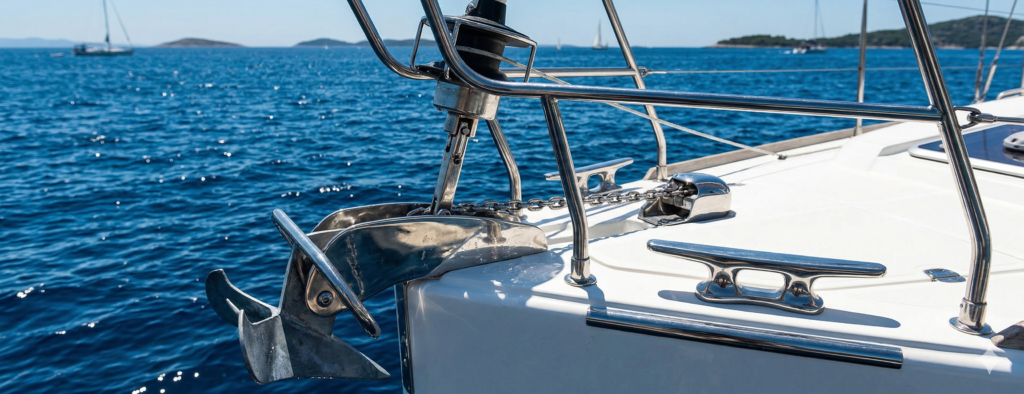
There are no small things on the open sea. Every pin, every screw, and every valve must function flawlessly. Yacht fittings represent a specialised sector of the industry where precision craftsmanship goes hand in hand with the material’s extreme durability. Components such as cleats, winches, and railings are constantly drenched by waves and exposed to scorching sunlight, which additionally heats the metal, accelerating chemical reactions. Acid-resistant steel is the only sensible choice here, as it is one of the few materials that retains its smooth surface, preventing the accumulation of salt crystals that could act like sandpaper on ropes and sails.
In the offshore industry, where drilling platforms operate under the harshest conditions on earth, the requirements go even further. Not only is 316L steel used, but often even more advanced Duplex steels. These are almost twice as strong as standard stainless steels and exhibit even greater resistance to stress corrosion cracking. Imagine acid-resistant pipes transporting oil or gas beneath the ocean floor – there is no room for the slightest flaw. This is space-age technology transferred to the ocean depths, where stainless steel proves its absolute superiority over other materials.
Attention should also be paid to filtration and desalination systems on ships. Without them, long voyages would be impossible. All stainless steel fittings in these systems operate in an environment with extreme salt concentrations, where water is subjected to immense pressure. The steel must be not only acid-resistant but also impeccably biologically clean to avoid affecting the quality of drinking water for the crew. This demonstrates how versatile inox steel is – protecting us from the ocean externally and safeguarding our health internally.
Caring for steel on a yacht: how to maintain inox in extreme conditions
Although acid-resistant steel is incredibly durable, even it requires a little care at sea. Listen, this is not a “fit and forget” material if you want your yacht to shine against the backdrop of a setting sun. The fundamental rule is to regularly rinse metal elements with fresh water. Salt that dries on the steel surface forms a white residue, which over time can lead to brown stains commonly referred to as “tea staining”. This is not yet deep rust but a warning signal that the passive layer needs assistance.
Professional steel care in the marine industry relies on specialised pastes and waxes that seal the metal’s structure and facilitate water runoff. From time to time, it is advisable to carry out a passivation process using dedicated chemical agents that refresh the natural protective chromium barrier. Thanks to this, metallurgical products on board will remain safe even during the longest tropical voyages. It is a small effort that translates into immense satisfaction from owning a beautiful and safe vessel that is not afraid of salty challenges.
In summary, the marine industry loves acid-resistant steel reciprocally. It is a material that has allowed us to tame the oceans and build structures our ancestors could not even dream of. Whether we are talking about a small cleat on a sailing yacht or powerful pipes on a drilling platform, 316L steel remains the silent hero of every maritime adventure. It is a quality that stands firm when the wind fills the sails and thousands of miles of salty depths lie beneath the keel. Investing in proper steel at sea is not just a matter of aesthetics – it is above all a matter of trust in a material that will never fail us in the heart of a storm.