
Choosing the appropriate material for a project is only half the success in the world of modern metallurgy. When opting for stainless steel sheets, it is essential to be aware that the same steel grade can appear completely different depending on how its outer layer has been prepared. Surface finishing is a parameter that determines not only the aesthetics of the final product but also its functional properties, ease of cleaning, and even resistance to specific types of corrosion. For the uninitiated, symbols such as 2B, BA or No. 4 may sound like a complicated code; however, in reality, they are precise designations of metallurgical standards that facilitate communication between the designer and the material supplier.
Understanding the differences between various types of finishes is crucial to avoid disappointment during assembly or operation. Metallurgical products undergo a series of mechanical and chemical processes before reaching the customer in the form of a finished sheet. Each stage of processing – from cold rolling, through annealing, to polishing – leaves its unique mark on the steel. In a professional steel service, the choice of finish is always dictated by the intended use of the material, as stainless steel operating inside an industrial tank must meet completely different standards than steel intended to become a decorative element of a modern elevator in a Class A office building.
Contemporary architecture and design increasingly boldly utilise the play of light on metal surfaces, making knowledge of steel textures indispensable for every engineer and decorator. Stainless steel sheets offer a spectrum of possibilities, from deep matt, through satin brushing, to a perfect mirror finish. Each of these options has its own specific characteristics and requires a different approach to maintenance. It is therefore worth taking a closer look at the technology behind these designations to consciously shape spaces where metal becomes not only a construction element but also a significant visual feature.
Metallurgical Standards – from Matt 2B to Shiny BA
The most commonly encountered and versatile surface type in the industry is the 2B finish. This is a standard surface obtained after cold rolling, annealing and pickling, which finally undergoes a process called skin-pass. This slight pass of the sheet through polished rollers gives it a uniform, silvery-matt shade with a subtle gloss. Stainless steel sheets with a 2B finish are chosen wherever function dominates over aesthetics, for example in machinery construction, process tanks or structural elements not exposed to public view.
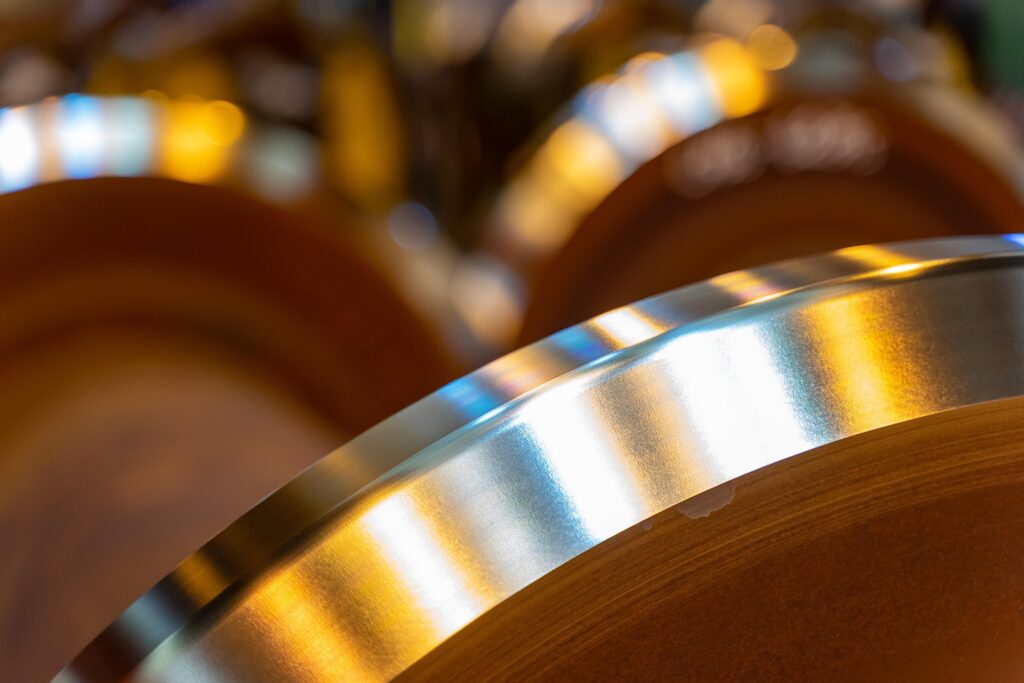
Aesthetically higher in the hierarchy is the BA finish, which stands for Bright Annealed. Its production process differs from standard annealing in that it takes place in a controlled oxygen-free atmosphere, preventing oxidation of the metal surface. As a result, the steel retains its natural high gloss obtained during rolling, without the need for additional mechanical polishing. The BA surface is smooth and shiny, although not yet a perfect mirror. It is often used in the production of household appliances, automotive accessories or decorative elements where high cleanliness and attractive appearance are required at a reasonable price.
The choice between 2B and BA is often a matter of balancing budget and visual expectations. The 2B surface is more resistant to scratches resulting from assembly processes, as its matt structure better conceals minor blemishes. Conversely, BA sheets are much easier to maintain in microbiological cleanliness, making them an attractive choice for the food industry. However, it should be remembered that fingerprints and water stains appear much more quickly on the glossy BA surface, which in visible installations necessitates more frequent maintenance.
Aesthetics and Functionality – Polished and Brushed Sheets
When metallurgical standards prove insufficient for the designer’s vision, polished sheets come into play. This finish is achieved mechanically by abrading the metal surface with belts of a specified grain size. The most popular polishing standards, such as K180, K240 or K320, define the density and depth of scratches on the sheet surface. Polished sheets are characterised by a directional texture that gives the metal a modern, technical appearance. This finish is highly valued in interior architecture, elevator construction, as well as in the production of catering and medical furniture.
Brushing is a variant of polishing that produces an even more subtle and matt effect. This process uses special abrasive fibre brushes that create very delicate, almost silky scratches on the steel surface. Such prepared stainless steel sheets are exceptionally practical for everyday use, as their texture excellently conceals daily wear marks and minor scratches. The brushed finish is synonymous with elegance and professionalism, often associated with prestigious projects where steel is to harmonise with natural stone or wood.
When planning an investment using polished sheets, particular attention should be paid to the direction of the polish. All sheets joined in one plane must have scratches oriented in the same direction; otherwise, under light, they will appear to be made of different materials. It is also worth knowing that mechanical surface treatment may slightly affect corrosion resistance in extremely aggressive environments, as micro-indentations from polishing can retain contaminants more often than the perfectly smooth 2B sheet. However, under standard urban and domestic conditions, this difference is practically imperceptible.
Mirror Sheets – When Steel Becomes an Element of Luxurious Design
For the most demanding applications, where steel is to serve as a mirror, dedicated mirror-finish sheets are used. Their production process is the most time-consuming and multi-stage, involving successive polishing of the surface with increasingly finer pastes and polishing wheels until all visible grinding scratches are completely removed. The highest standard in this category is the so-called Super Mirror (No. 8), which offers a reflection quality almost identical to that of a classic glass mirror. Such metallurgical products adorn the most exclusive hotels, boutiques, and prestigious staircases.
Mirror-finish sheets have the advantage over glass in that they are incomparably more resistant to impacts and cracking. They provide an excellent solution in public utility areas where safety is a priority, yet the optical effect of space enlargement is desired. Mirror stainless steel perfectly reflects light, brightening dark corridors and giving them a luxurious character. However, it should be remembered that this is the most demanding finish in terms of cleanliness – every spot or streak is immediately visible, which is why such sheets are usually supplied with thick protective films that are only removed after all installation work is completed.
The choice of a high-gloss polished surface also entails the necessity of using appropriate installation tools and chemical agents. No abrasive materials or aggressive acids should be used to clean mirror sheets, as they could dull the delicate metal structure. Regular wiping with a soft microfiber cloth using dedicated stainless steel care products will preserve the depth of reflection for many years. This is an investment in aesthetics that, with proper treatment, rewards with an impeccable appearance, defining a modern premium finishing standard.
How to choose the finish for a specific project?
The decision to select a particular finish should always be preceded by an analysis of the conditions in which the material will operate. If designing external railings on a terrace by a busy street, the best choice will be ground sheets with a grit of K240 or K320. Their surface is smooth enough not to retain dirt, while the grinding texture effectively masks minor mechanical damage, which is inevitable in public spaces. Stainless steel in this form guarantees durability and aesthetics without requiring daily intervention by cleaning services.
Conversely, in the medical or pharmaceutical industry, where sterility is paramount, stainless steel sheets with a 2B finish or electrochemically polished are unrivalled. The less porous the surface, the lower the chance of bacterial colony development and the easier the disinfection with steam or strong disinfectants. Here, aesthetics take a back seat, and hygienic safety and compliance with sanitary standards become the priority. Professional metallurgical products for these sectors must have certificates confirming not only the grade but also the surface finish quality measured by the roughness parameter Ra.
In summary, the world of stainless steel finishes is a fascinating combination of materials engineering and applied art. Each designation, from 2B to Super Mirror, carries a promise of specific benefits and challenges. The key to success is cooperation with an experienced supplier who will help select the material so that the surface finish harmonises with the construction and surroundings. Stainless steel is a material unafraid to be in the spotlight, and the appropriately chosen sheet texture is the best way to emphasise the quality and professionalism of the entire undertaking.